Research
We Asked ChatGPT, Claude, Gemini and Perplexity the Same 24 AI SEO Questions
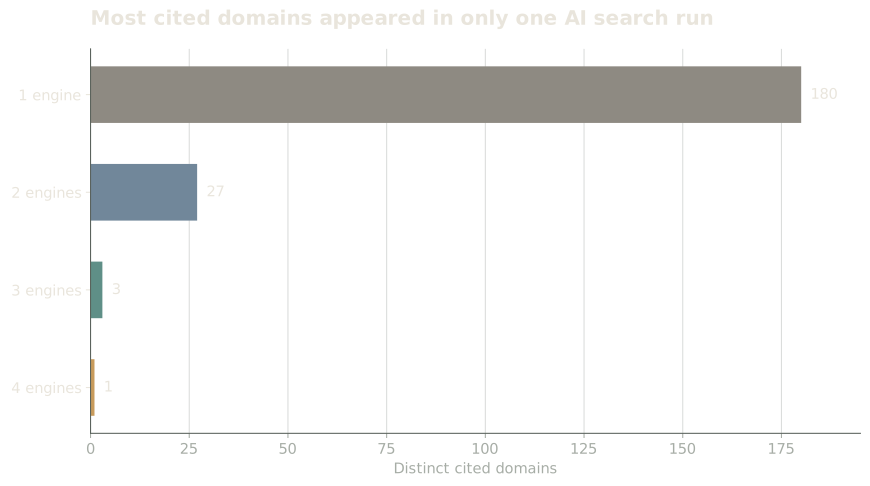
The four runs cited 211 different domains.
Only one appeared in all four.
It was the first result that made us stop looking at AI visibility as a single score.
The second came from the agency-selection questions. Companies were often recommended without their own websites appearing in the sources supporting the answer.
Then we looked at who owned those sources.
Of the 67 source owners appearing across the six provider-selection prompts, 42 were agencies or service providers themselves.
This study looks at what ChatGPT, Claude, Gemini and Perplexity surfaced when we asked the same 24 non-branded questions about AI search visibility, technical discovery and choosing a provider.
It is not an agency ranking.
It is a look at the evidence underneath the answer.
24 fixed prompts4 AI search experiences96 answers reviewed211 distinct cited domains1 domain cited by all four
At a glance
- 24fixed prompts
- 4AI search experiences
- 96answers reviewed
- 211distinct cited domains
- 1domain cited by all four
Explore the findingsDownload the full dataset (.zip) ↓Read the methodology
01
Key Findings
The four AI platforms did not treat provider recommendations and supporting sources the same way. A brand could appear in an answer without its own website being cited.
The sources behind those recommendations also had a clear commercial tilt: agencies and service providers accounted for the largest share in these runs.
The results below describe this study's four documented runs, not how every platform will behave for every user or query.
What did the study find?
Across four AI-search runs using the same 24 prompts, we recorded 211 distinct cited domains. Only one appeared across all four. In agency-selection answers, brands were often surfaced without their own websites being cited, and most of the source owners behind those answers were businesses selling services or software in the same broad market.
| Finding | Result |
|---|---|
| Fixed prompts tested | 24 |
| AI search environments | 4 |
| Answers reviewed | 96 |
| Distinct cited domains | 211 |
| Domains cited by all four runs | 1 |
| Domains cited by three runs | 3 |
| Domains cited by two runs | 27 |
| Domains cited by one run only | 180 |
| Engine | Rate |
|---|---|
| ChatGPT | 9.7% |
| Claude | 11.3% |
| Gemini | 26.7% |
| Perplexity | 40.2% |
| Source owner | Count |
|---|---|
| Agency / service provider | 42 |
| Software / platform | 12 |
| News / editorial | 5 |
| Community / social | 3 |
| Directory / marketplace | 2 |
| Practitioner / consultancy | 2 |
| Search trade publication | 1 |
| Total | 67 |
02
211 Domains. One Appeared Everywhere.
Most of the cited web was not shared.
Of the 211 domains we recorded:
180 appeared in one run only.
27 appeared in two.
3 appeared in three.
1 appeared in all four.
The three domains appearing across three engines were:
searchbloom.comstrativera.comyesoptimist.com
The only domain appearing across all four was:
thriveagency.com
The result needs context.
We did not score Thrive as the best or most authoritative source. We did not assign editorial-quality points, and recurrence was never treated as a proxy for independence.
What the result shows is narrower: agency-owned comparison content can travel across multiple AI search experiences when the question is about choosing a provider.
Searchbloom, Strativera and Optimist point in the same direction.
These companies publish in a category where they also compete. That commercial relationship belongs in the interpretation of the source, rather than being hidden because the page was cited.
Looking at one AI platform would have shown only part of what was happening. We keep citation results separate by platform before rolling them into any summary.
| Coverage | Domains |
|---|---|
| 1 engine | 180 |
| 2 engines | 27 |
| 3 engines | 3 |
| 4 engines | 1 |
03
Recommendation and Citation Were Often Different Events
The first six prompts all asked some version of the same commercial question:
Which agency should I hire?
For every brand surfaced in those answers, we checked whether the company's own domain appeared in the same answer's visible source list. The gap was substantial.
A company could appear in the recommendation even when its own site was not among the visible sources, which changes what a useful visibility report needs to tell you.
If a company appears in an AI answer, there is a real difference between:
- the company's website supplying the source;
- another publisher supplying the source;
- the company being mentioned without its domain appearing at all;
- the company being discussed but not actually recommended.
Those are different outcomes.
They should not be collapsed into one “visibility” number before the underlying evidence is preserved.
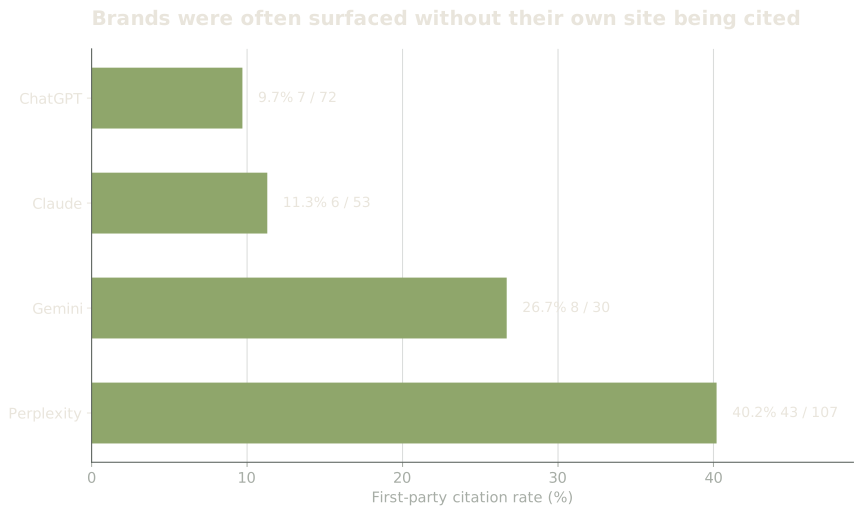
For the six provider-selection questions, being recommended did not mean a brand's own website was being used to support the answer. The share of answers citing the brand's own site varied sharply across the four runs.
What counted as a first-party citation?
In this study, a first-party citation simply means the surfaced brand's own website appeared in that answer's source list. A LinkedIn post did not count as first-party simply because the company published it. Neither did Medium, Reddit or another third-party platform.
Two Perplexity mappings are worth documenting because another person reproducing the analysis could reasonably pause on them:
- Third (3RD) was matched to
get3rd.combecause the raw organization entry identified that relationship. - SEMrush agency directory was matched to
agencies.semrush.com, an owned Semrush subdomain.
The final Perplexity count of 43 out of 107 was checked manually brand by brand during independent QA.
| Engine | Appearances | Own domain cited | Rate |
|---|---|---|---|
| ChatGPT | 72 | 7 | 9.7% |
| Claude | 53 | 6 | 11.3% |
| Gemini | 30 | 8 | 26.7% |
| Perplexity | 107 | 43 | 40.2% |
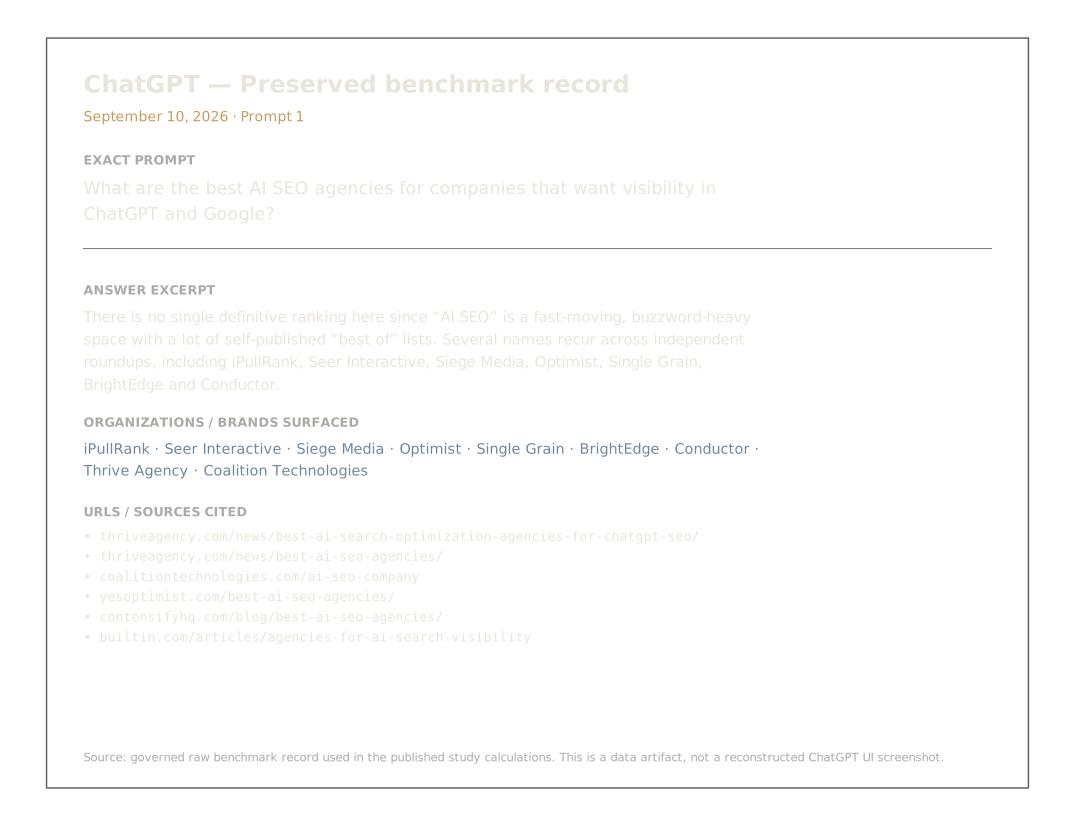
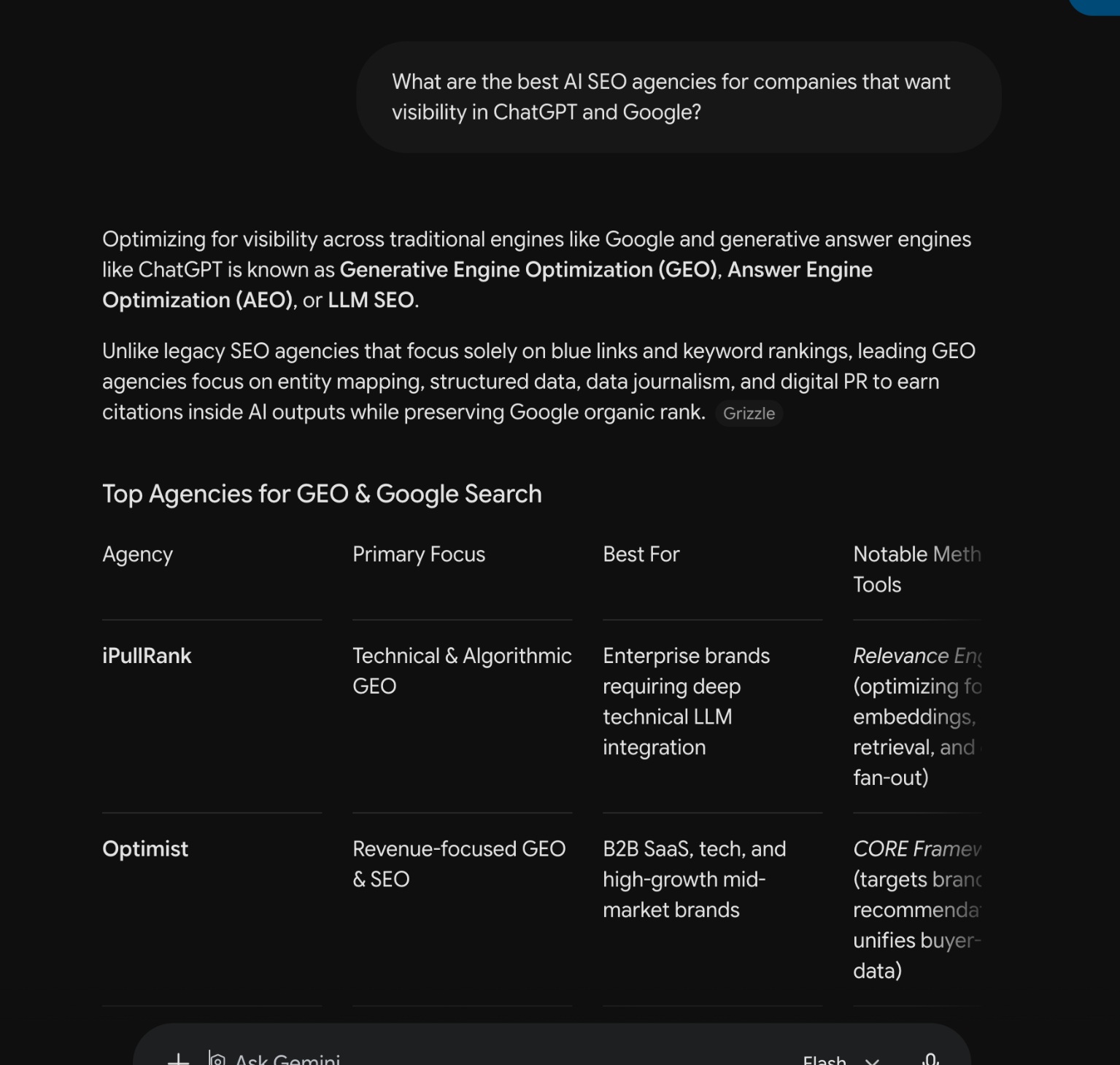
Prompt 1, as asked
What are the best AI SEO agencies for companies that want visibility in ChatGPT and Google?
ChatGPTPreserved benchmark record, September 10, 2026
ClaudeInterface capture, privacy-cropped
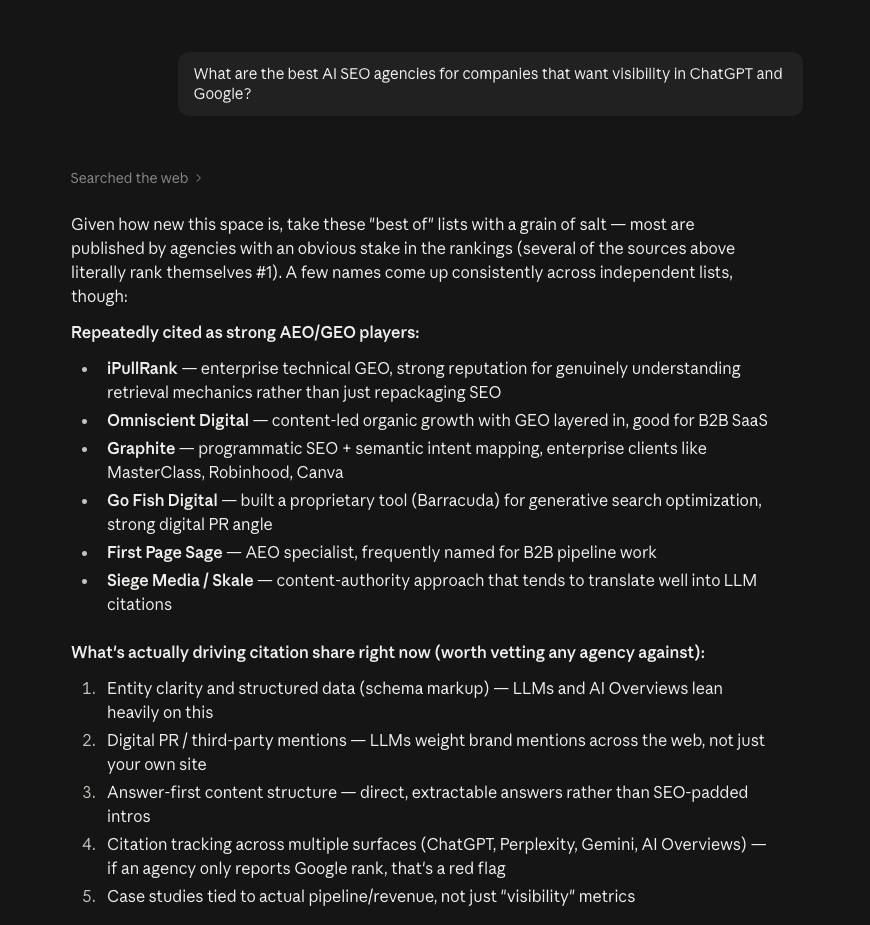
GeminiInterface capture
PerplexityInterface capture
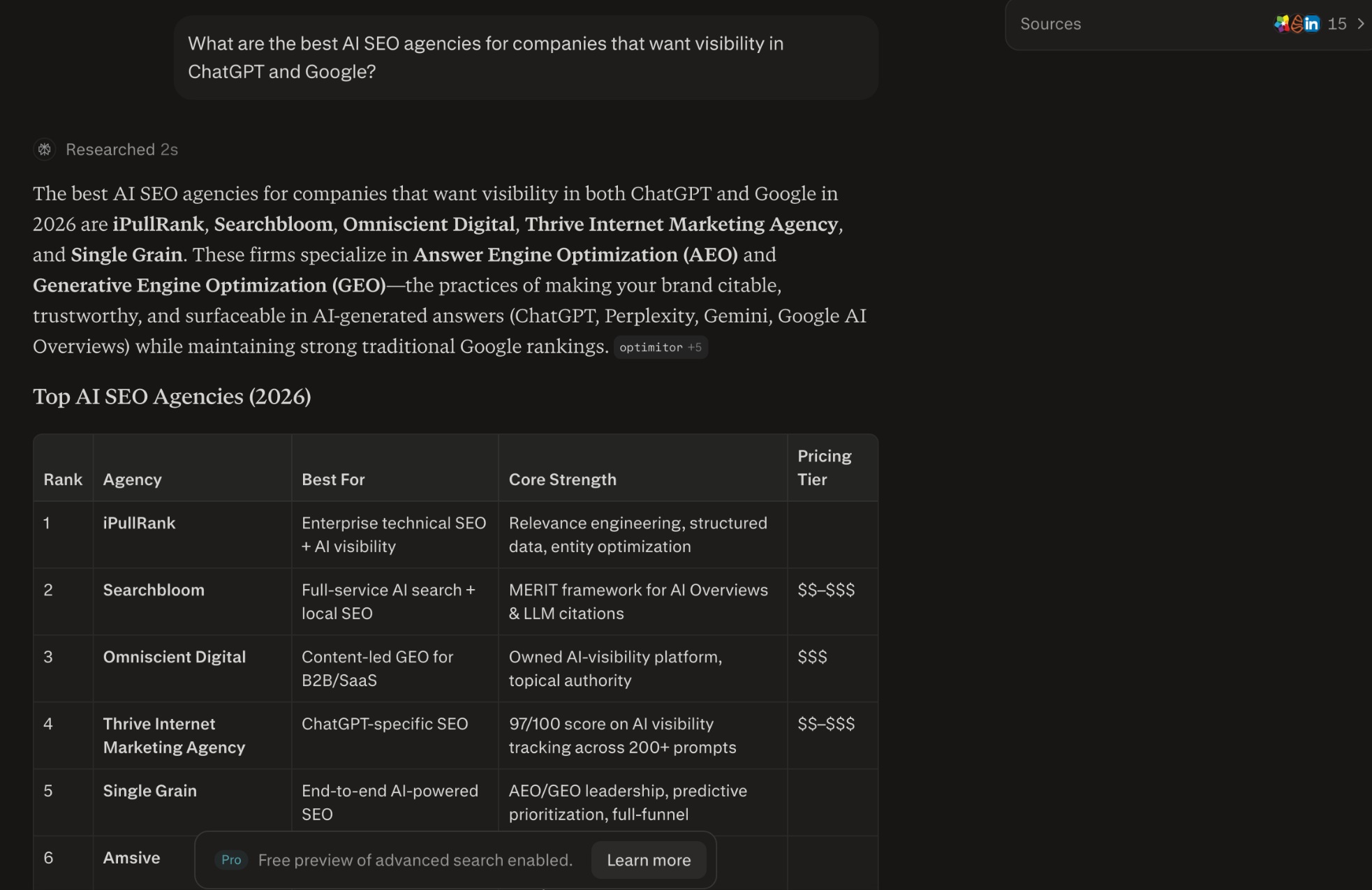
The same provider-selection question produced different recommendation structures and source treatments across the four documented runs. ChatGPT is a preserved benchmark record rather than an interface capture, because the ChatGPT screenshots originally supplied were not from the governed September 10 run.
04
Most Sources Behind Agency Recommendations Were Owned by Agencies
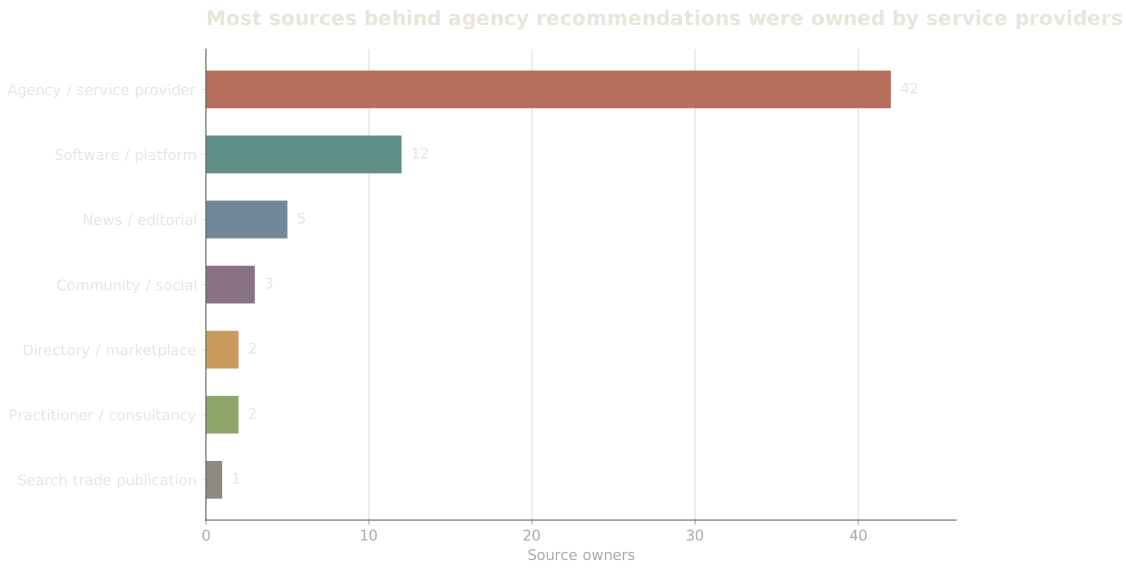
We then looked at the ownership of the sources behind the six provider-selection prompts. This produced one of the clearest commercial findings in the study.
42 of 67 source owners, or 62.7%, were agencies or service providers.
Software companies accounted for another 12. Only two were directories or marketplaces.
The point is not that commercial sources are automatically bad sources. Some of the agency and software content in this dataset was useful, specific and well researched. The point is that much of the information supporting these buying-oriented answers came from organizations with a commercial stake in the same market.
Commercial overlap matters when a business leader sees an AI-generated list of “best” providers and assumes the answer is assembled from neutral editorial recommendations. In these runs, it usually wasn't.
The source mix tells another part of the story. When we grouped the cited sources by who owned them, agencies and service providers made up the largest share. In other words, provider recommendations were often supported by companies participating in the same market, not just independent publications or the recommended brand's own site.
| Source owner | Count |
|---|---|
| Agency / service provider | 42 |
| Software / platform | 12 |
| News / editorial | 5 |
| Community / social | 3 |
| Directory / marketplace | 2 |
| Practitioner / consultancy | 2 |
| Search trade publication | 1 |
| Total | 67 |
Commercial ownership does not make those sources wrong. It does mean recommendations and citations should be measured separately, with source ownership kept in view.
These figures describe the four runs in this study. They are not estimates of how each platform behaves for every user, account state or query.
Counting note
The raw citations contained 68 hostnames. Because semrush.com and the Semrush-owned agencies.semrush.com belong to the same company, we counted them as one source owner. That left 67 source owners for this part of the analysis. We grouped sources by the organization that owned the publishing property, not by what one individual page happened to look like.
05
Buyer Questions Pulled From a More Commercial Web
The source mix changed when the question moved closer to a purchase.
The first six prompts asked which agencies or providers could help a company improve its visibility in AI-generated answers. Agency roundups appeared frequently. So did software companies, provider comparisons, commercial guides and practitioner content. Gemini's visible citations in this run were concentrated entirely in those six provider prompts. Claude's citations for those provider-selection questions also came entirely from commercial, vendor or practitioner-owned sources. ChatGPT and Perplexity showed broader source sets, but the buying questions still leaned heavily toward organizations participating commercially in the category.
The pattern is useful for two reasons. First, it explains why strong first-party content alone may not be enough to influence provider discovery. Second, references from other credible sites matter more, but they also need context. There is a meaningful difference between earning a mention in a respected publication and buying a spot in an agency ranking built to sell placements. We would not treat those as equally credible references.
06
We Refused to Rank the Engines by Citation Count
The raw totals make a leaderboard tempting. Perplexity exposed far more visible sources. Gemini exposed far fewer.
The difference doesn't tell us which system was “better researched,” because the run conditions were not symmetrical enough to support that conclusion.
ChatGPT
The preserved run states that live web research was used to ground the answers.
Its raw benchmark file did not contain the same standardized run-details block used in the later three runs, so we identify the engine from the governed study record rather than from the file itself.
Our original ChatGPT count was also wrong.
We first recorded:
90 citation entries
71 unique domains
An independent recount of the raw file produced:
92 citation entries
64 unique domains
We corrected the data.
The correction did not change the headline finding: 211 domains overall, with the same 180 / 27 / 3 / 1 overlap.
Claude
Claude's run used three broad web searches before the complete prompt set, then applied judgment across the answers. Some prompts received no citations because no additional search was invoked. That partly reflects how this run was conducted, not a hard limit on how many sources Claude can cite.
Perplexity
Perplexity used live web search throughout the run and exposed the largest set of sources in the study. Its run also disclosed account personalization. We disclose that personalization existed without publishing private account details.
Gemini
Gemini reported search as enabled and active. Visible source records still appeared only on prompts 1 through 6.
The raw Gemini file used Markdown links that repeat each URL as both link text and link target. A literal URL parser therefore sees 42 URL occurrences, but those represent 21 visible source records. We use 21 in the comparison table and preserve the 42-occurrence formatting artifact in the downloadable dataset for auditability.
Gemini's pattern differs from Claude's known choice not to invoke search for some answers. We can observe the difference. This study does not tell us precisely why it happened.
Observed run conditions, not an engine quality ranking.
ChatGPT
24/24 prompts with visible citations
92 visible source records
64 unique cited domains
Claude
18/24 prompts with visible citations
56 visible source records
21 unique cited domains
Perplexity
24/24 prompts with visible citations
225 visible source records
156 unique cited domains
Gemini
6/24 prompts with visible citations
21 visible source records
6 unique cited domains
The governed Gemini file contains 42 literal URL occurrences because each Markdown link repeats the URL as both link text and link target. Those 42 occurrences represent 21 listed source records.
What QA changed
- Original ChatGPT tally
- 90 citation entries / 71 domains
- Independent raw-file recount
- 92 citation entries / 64 domains
- Cross-engine overlap
- unchanged
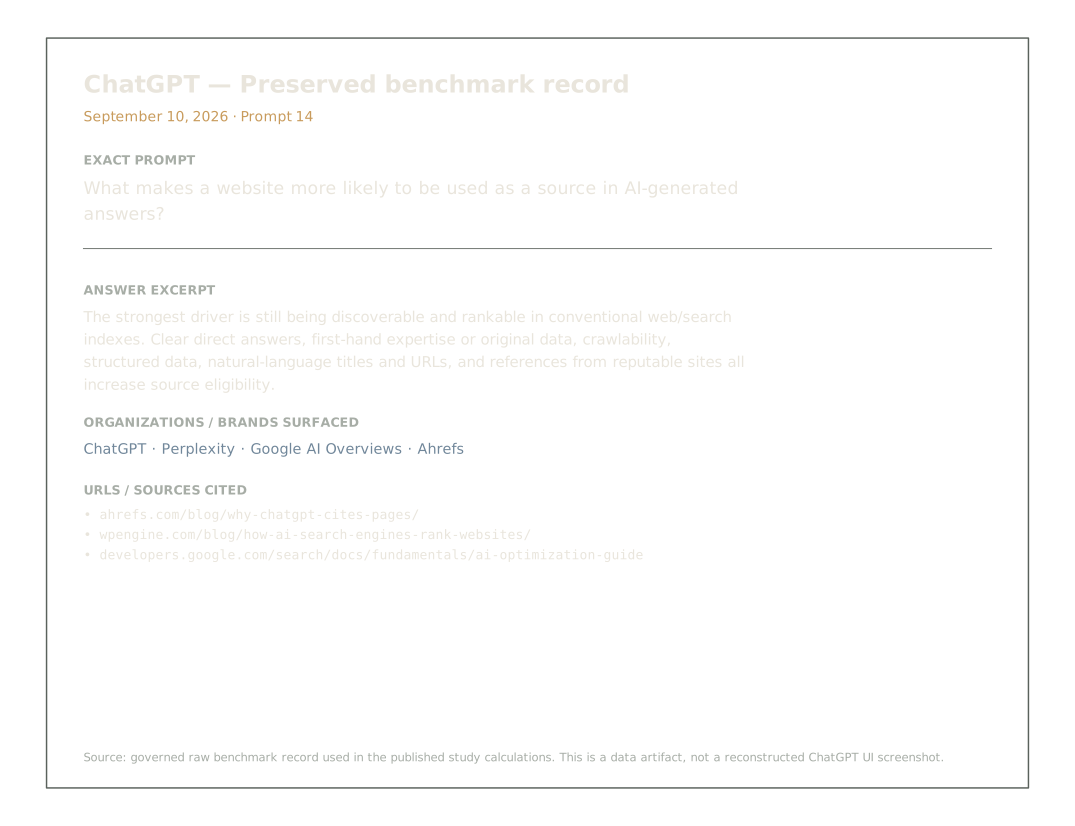
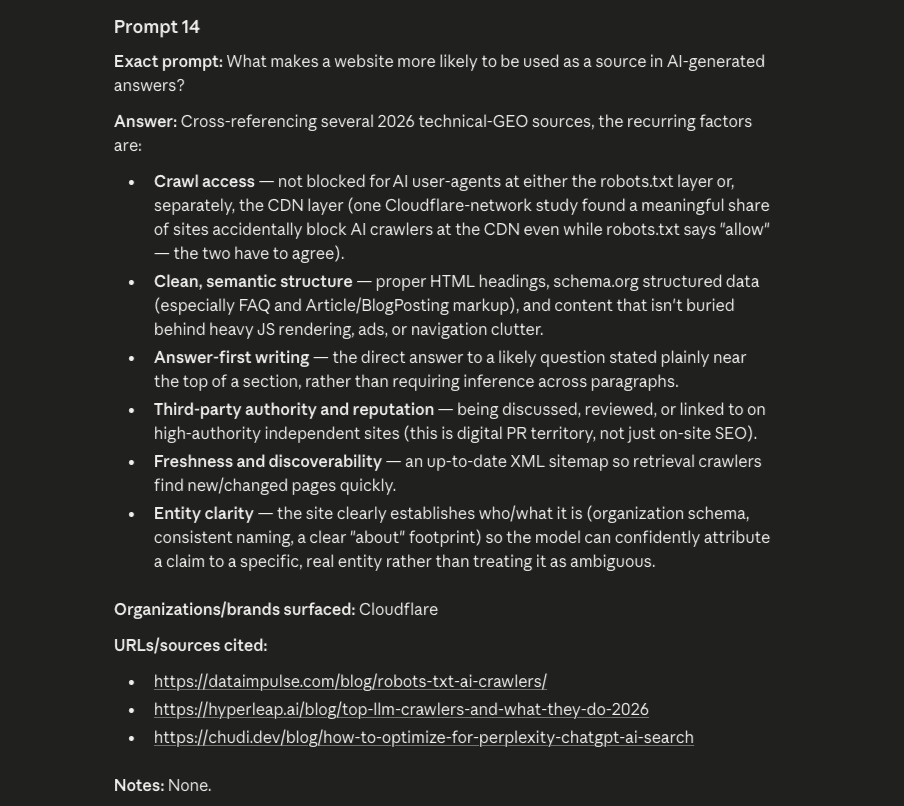
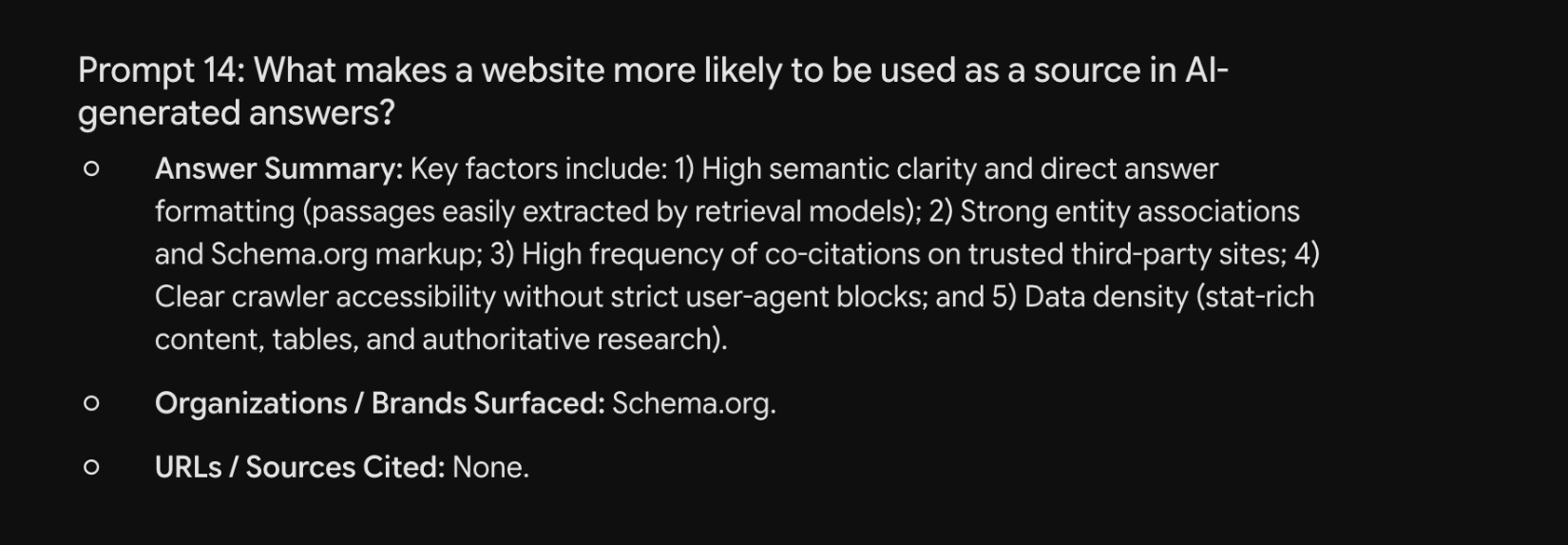
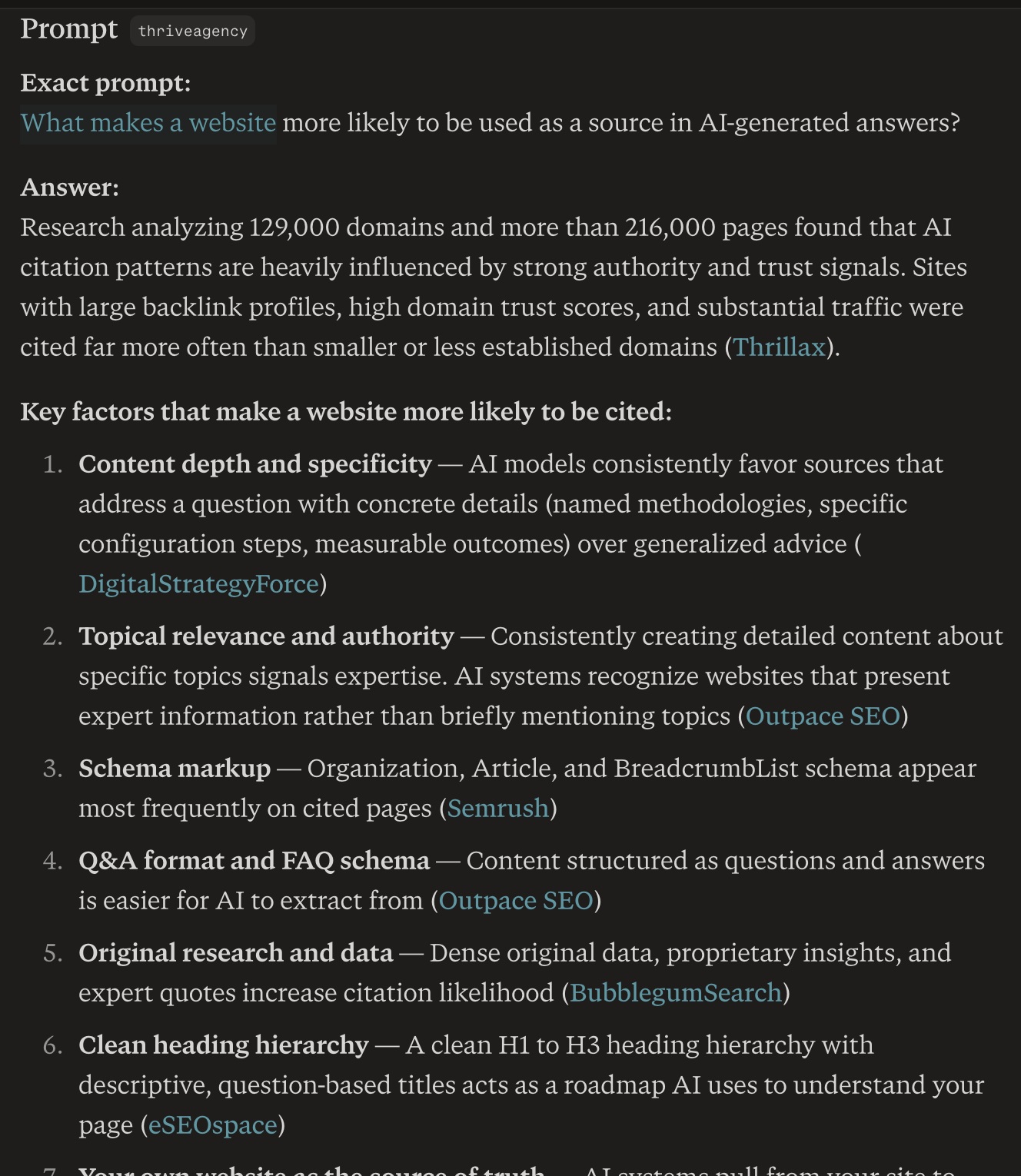
Prompt 14, as asked
What makes a website more likely to be used as a source in AI-generated answers?
ChatGPTPreserved benchmark record, September 10, 2026
ClaudePreserved benchmark record
GeminiPreserved benchmark record
PerplexityRecord 1 of 2: the answer
PerplexityRecord 2 of 2: the source list
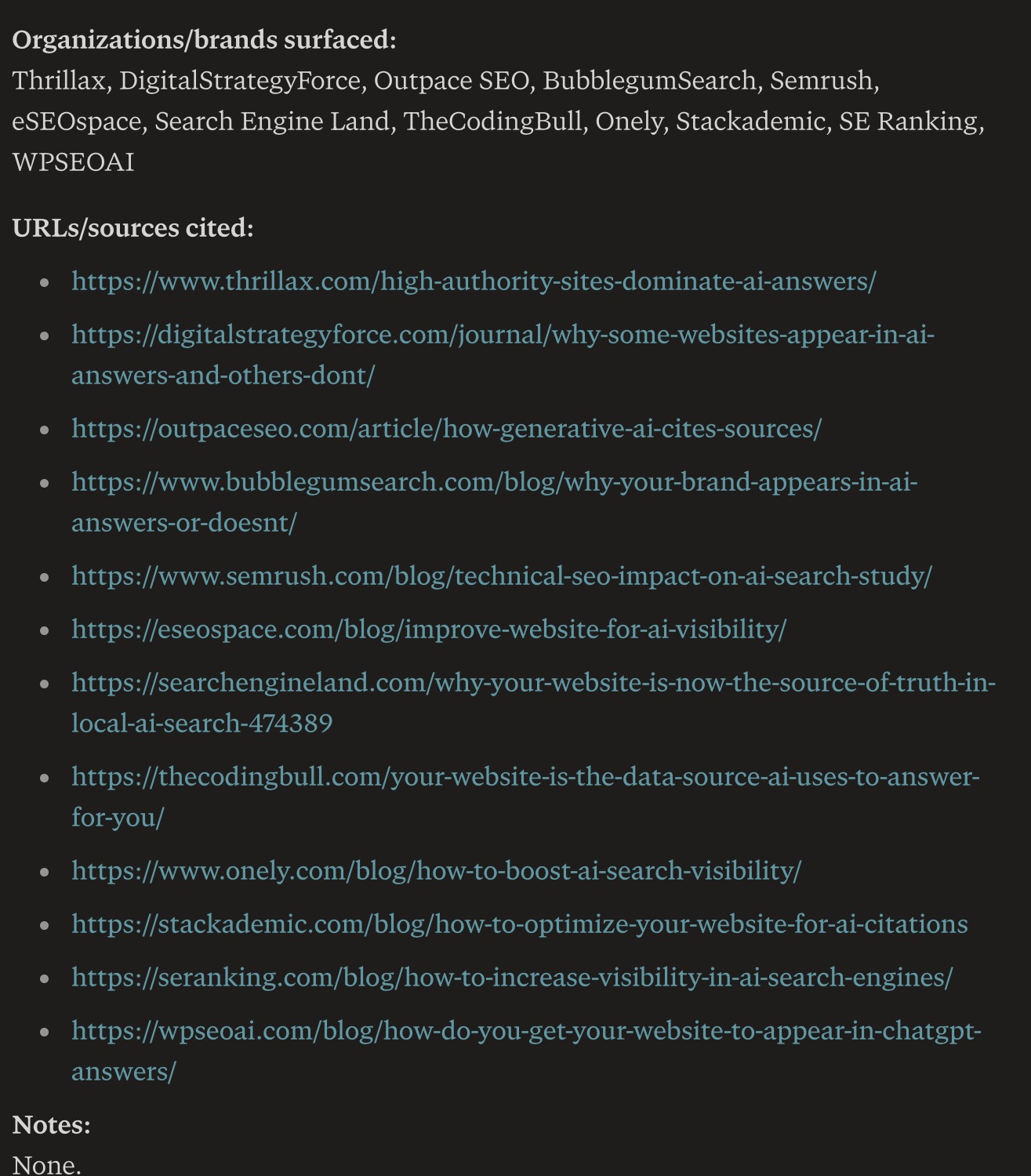
Preserved records from the same Prompt 14 benchmark question show different visible source behavior across the four documented runs. The two Perplexity captures are one evidence unit, kept as two records rather than stitched into a single image.
07
Different Questions Pulled From Different Parts of the Web
The technical and research questions looked different from the provider-selection questions. ChatGPT drew from a mix of search-industry publications, practitioner research, vendor material, academic sources and official documentation.
Perplexity surfaced a much broader set of sources. Claude's visible citations leaned more heavily toward practitioners and web publishers, while Gemini did not expose visible citations for prompts 7–24 in this run.
The point is not to decide which mix looks more sophisticated. Different questions pulled from different parts of the web, and the mix also varied by run.
A question about which agency to hire did not draw from the same part of the web as a question about crawler access, measurement methodology or experiment credibility. What someone asks is part of the visibility picture, not just which platform you check.
08
What We Would Measure Differently
This study changed the way we think about AI visibility reporting. A single score can still be useful as a summary. It should not replace the evidence underneath it.
At minimum, we want to preserve:
- Brand mention
Did the company appear at all?
- Recommendation
Was it actually presented as a provider, option or solution?
- First-party citation
Did the system expose a source from the company's own web property?
- Third-party corroboration
What outside source appeared alongside or behind the recommendation?
- Exact citation URL
Which page was used?
- Prompt
What was the person asking?
- Platform and run conditions
Where did the result occur, and under what documented conditions?
- Did it happen again?
Did the same result appear again later?
These fields answer different questions. Only after we preserve those details does it make sense to roll them into a summary score.
09
What This Means for Your Search Visibility
Making your own site easier to understand, crawl and cite still matters. The study does not argue otherwise. It shows why that work is only part of the job.
Brands in these agency-selection answers were often surfaced without their own websites being cited. Credible references from other sites are part of the visibility picture too.
For us, the practical test is straightforward.
For a business, the practical takeaway is simple: measure each AI platform separately, and track recommendations and citations as different outcomes. Then look for the gaps: where competitors appear and you do not, where your brand is mentioned without your site being cited, and which credible outside sources keep shaping the answers in your category.
The goal is not to chase every citation. It is to understand which parts of your search visibility you can improve, make the changes that are actually in your control, and then measure whether the picture changes.
Publish work worth citing
- Research.
- Useful experiments.
- Clear technical explanations.
- Public data.
- Methods another team can inspect.
- Failures that teach something.
The test is whether the work would still be worth reading if there were no sales CTA at the end.
Give other people a reason to reference it
Credible references can come from editorial coverage, expert contributions, research citations, practitioner discussion, credible partner references or other legitimate mentions. It does not require buying a “top agency” badge.
The backlink can be a useful outcome. It should not be the reason the reference had to be manufactured.
10
Definitions Used in This Study
- Brand mention
A company or organization appears in the response.
- Recommendation
The company is presented as a provider, option or solution.
- Citation
A visible source or URL is supplied with the answer.
- First-party citation
The cited source belongs to the surfaced brand's owned web property.
- Third-party citation
The supporting source is hosted on another organization's property.
- Prompt-engine observation
One fixed prompt evaluated in one AI search environment.
- Citation recurrence
A cited source appears across more than one prompt or engine, depending on the analysis being discussed.
These are separate because they describe different parts of the answer.
11
What This Study Does Not Establish
- We ran one documented benchmark per engine.
- The four environments did not use identical search, source-selection or personalization conditions.
- The results therefore do not describe every ChatGPT, Claude, Gemini or Perplexity user.
- We cannot show that a particular citation caused a recommendation.
- Citation frequency is not a quality score.
- A larger visible source count does not make one system better.
- A repeat test may produce a different mix of sources.
- The ChatGPT benchmark also predates the standardized run-details block used for the other three files.
For those reasons, we describe this as a four-engine observational study rather than a controlled comparison of the underlying models.
The claims are deliberately narrower than the dataset.
12
Methodology
We created 24 fixed, non-branded prompts across five broad areas:
- Provider selection: Prompts 1–6
- AI visibility measurement: Prompts 7–12
- Technical discovery: Prompts 13–18
- Research and experiment credibility: Prompts 19–23
- Integrated search strategy: Prompt 24
The same prompt set was evaluated through:
ChatGPT
Claude
Perplexity
Gemini
Across the four platforms, the 24 prompts gave us 96 answers to compare.
For each answer, we preserved:
- the exact prompt;
- the full response;
- organizations and brands surfaced;
- visible sources and URLs;
- run notes;
- available details about how each run was conducted.
Brand appearances and citations were recorded separately.
We cleaned domain names into a consistent format before comparing overlap across platforms.
For Gemini, each Markdown source link repeats the same URL as both visible link text and link target. We therefore count one listed source as one visible source record in the engine comparison, while the dataset retains the two literal URL occurrences for transparency.
For the buyer-source analysis, clearly co-owned properties were grouped under the same owner. That is why 68 literal hostnames became 67 source owners in that part of the study.
Commercial ownership, repeat appearances and editorial quality are different things. We did not treat one as proof of another.
Independent QA
The quantitative layer was independently recomputed against the raw benchmark files before publication.
The review confirmed:
- confirmed the 211-domain total across all four runs;
- confirmed the 180 / 27 / 3 / 1 overlap distribution;
- confirmed all four first-party citation rates;
- found and corrected the ChatGPT citation-count error;
- manually verified the Perplexity first-party total;
- independently checked the 67-source ownership set for the provider-selection questions;
- corrected two source-owner classifications before the ownership finding was approved.
The corrected data is what appears here.
13
Explore the Dataset
You should not need to accept our interpretation in order to inspect the study.
The public dataset contains the records used to build the findings.
prompts.csv
One row per prompt, including the prompt ID, wording and category.
citations.csv
Citation records including:
- engine;
- run date;
- prompt ID;
- cited URL;
- normalized domain;
- source owner/type;
- first-party match;
- notes.
brands.csv
Brand records including:
- engine;
- prompt ID;
- surfaced brand;
- normalized brand;
- owned domain;
- first-party citation status;
- mapping note.
methodology.txt
Run conditions, definitions, normalization rules, known asymmetries, QA corrections and limitations.
README.txt
A plain-language guide to the files.
The public package will not contain account identifiers, private personalization details, session information or unrelated workspace data.
Download the full dataset (.zip)prompts.csv · citations.csv · brands.csv · methodology.txt · README.txt · VALIDATION.txt
14
Run It Again
We hope people do.
- Repeat the prompts.
- Use another account state.
- Standardize search invocation more tightly.
- Add another engine.
- Change the provider questions.
- Reclassify the sources.
- See whether the first-party citation gap holds.
- See whether the shared source set gets larger or smaller.
If a repeat produces different results, that is useful evidence too. We would rather have the work tested than see the headline number repeated without its conditions attached.
15
The Sources Underneath the Answer Are the Story
The answer can look settled even when the evidence underneath it is not.
In these four runs, the same 24 questions produced 211 cited domains. Most appeared on only one platform. Brands were frequently recommended without their own domains being cited. Agency and service-provider websites made up most of the source owners behind the provider-selection answers. Technical and research questions pulled from a different mix again.
None of that fits comfortably inside one visibility score. We don't think it should.
- Preserve the question.
- Preserve the exact source.
- Preserve where the result appeared.
- Keep the recommendation separate from the citation.
- Then look for what changes.
You end up with evidence you can investigate, instead of a number you can only watch.
Next step
Want to Understand Where Your Brand Actually Shows Up?
DankRank looks at visibility across Google, AI answers, Maps and paid search without treating every signal as the same thing.